Beneath the Gold Leaf: The Laboratory Where Sacred Icons Confess Their Secrets
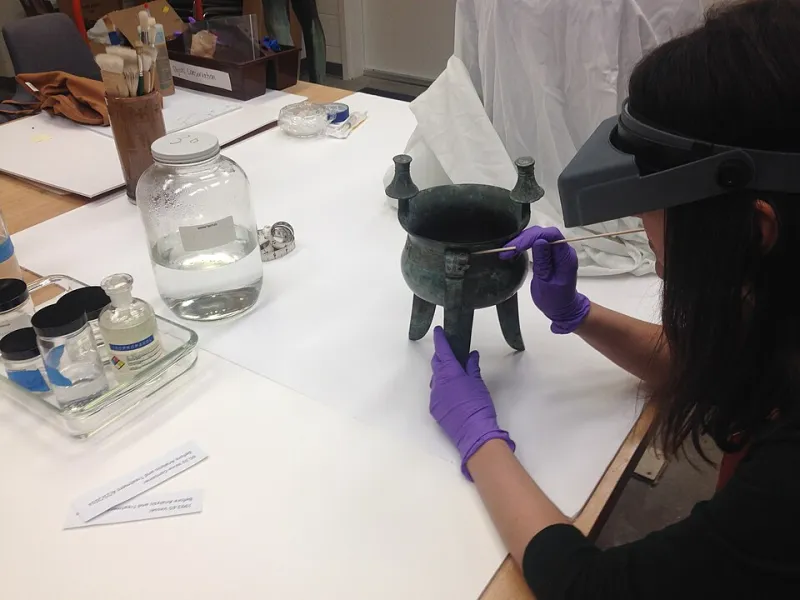
Photo: RichardMcCoy, CC BY-SA 3.0, via Wikimedia Commons
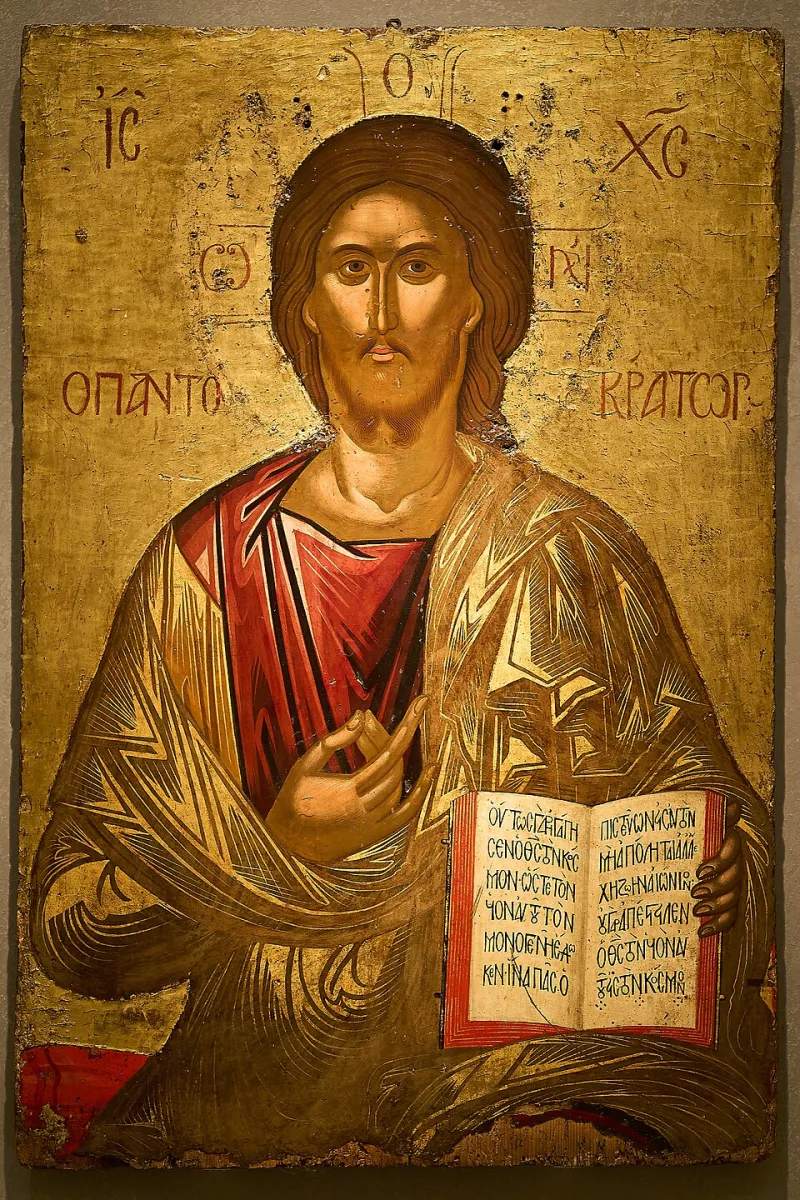
In a conservation laboratory lit by the flat, unforgiving glow of examination lamps, a nineteenth-century Byzantine-style icon of Saint Nicholas rests on a padded easel. To the untrained eye, the saint is exactly as his last painter left him: solemn, gold-haloed, unchanged for generations. To the instruments gathered around him, however, the panel is a palimpsest — a document written, erased, and rewritten across centuries.
At Iconsete, we believe that stewardship of sacred art begins with listening to what objects can tell us about themselves. Increasingly, that listening happens not with the naked eye but with photon beams and spectrometers.
The Light That Sees Through Paint
The workhorse of modern icon conservation is X-ray fluorescence, or XRF. The technique is elegantly simple in principle: a directed X-ray beam causes the atoms in a pigment to fluoresce, emitting secondary radiation at energies unique to each element. Read those emissions, and you know whether the artist ground vermilion from mercury, lead white from a European workshop, or orpiment — an arsenic-based yellow — into the paint layer.
Crucially, XRF is non-invasive. No scraping, no sampling, no loss of original material. For an organization committed to preservation, that distinction is everything. A sacred image is not merely an artwork; it is a devotional object whose integrity carries religious and cultural weight. The examination must leave the icon exactly as it arrived.
What XRF reveals is often startling. When our colleagues at a New England regional conservation center examined a Greek Orthodox icon acquired by a Massachusetts family in the 1910s, the instrument detected a halo of gold beneath the robe of a secondary figure — evidence that the "companion saint" had been added over an original composition, possibly to satisfy a later patron's devotion or a dealer's desire for a fuller iconostasis.
Underdrawings and the Painter's First Thought
Infrared reflectography offers a complementary window. Many icon painters began with a charcoal or ink underdrawing on the prepared gesso ground. Carbon-based drawing materials absorb infrared light in wavelengths where most paint layers are transparent, allowing a modified infrared camera to record the artist's first intentions.
These underdrawings are intimate things. They show corrections — a raised arm repositioned, a face shifted a few millimeters — and reveal workshop practice, since preparatory drawings were often copied from pattern books passed between generations. When an underdrawing matches a known Cretan model, scholars can begin to trace the icon's artistic lineage with a specificity that stylistic analysis alone cannot provide.
On one panel examined for a Midwest diocesan collection, reflectography exposed a fully drawn second figure beneath the visible Saint George, later overpainted with a saddle and lance. The original figure's elongated fingers and angular drapery pointed to a hand trained in the post-Byzantine tradition of the Ionian Islands, revising the panel's attributed origin by hundreds of miles.
Raman Spectroscopy and the Geography of Color
If XRF identifies elements and reflectography recovers drawings, Raman spectroscopy identifies molecules — the actual chemical compounds of the pigment. A focused laser, carefully kept below the threshold that could heat or fade a historical paint, scatters light in patterns as distinctive as a fingerprint.
The results read like a map of the medieval and early modern world. Natural ultramarine, derived from lapis lazuli mined in the Sar-e-Sang district of Afghanistan and ground more precious than gold, signals a patron who could afford the finest materials or a trade route that carried the pigment through Venetian markets. Smalt — a cobalt glass produced largely in northern European furnaces — suggests a different supply chain entirely.
And then there are the American surprises. Icons and panel paintings in New England collections have yielded verdigris, the copper-based green made by treating copper sheets with vinegar, produced in small colonial workshops in Boston and Newport. Its presence on an object long assumed to be purely European import complicates the story: someone on these shores was retouching, repairing, or repainting sacred images using local materials. The icon was not a frozen relic of the Old World but a living object, tended by hands in the New.
Rewriting Provenance, One Spectrum at a Time
The cumulative effect of this work is a quiet revolution in scholarship. Provenance — the documented history of an object's ownership — has traditionally relied on invoices, diaries, and the often-unreliable attributions of dealers. Scientific examination adds an independent witness. If a pigment did not exist before 1700, the panel cannot have been painted in 1650. If the ground layer matches others from a known Dalmatian workshop, attribution can be strengthened or overturned.
For American collectors and institutions, this matters urgently. Sacred icons arrived in the United States through missionaries, immigrants, Grand Tour travelers, and — less comfortably — the dispersal of church property abroad. Understanding what these objects are, and how they came to rest in a parish hall in Cleveland or a university gallery in New Haven, is part of the ethical obligation of holding them.
Stewardship as an Ongoing Dialogue
None of this diminishes the devotional power of the icon; if anything, it deepens it. Every repainted saint testifies to a community that loved the image enough to renew it. Every Afghan lapis blue connects a village church to the long arteries of human exchange.
The laboratory, in this sense, is not opposed to the sanctuary. It is another room in the same house — a place where the past, coaxed gently by light and chemistry, is permitted to speak. Our task, as scholars and stewards, is to listen carefully and to record faithfully what we hear, so that the next generation inherits not just the images, but the fullness of their stories.