Two Hundred Fifty Years On: A Conservation Calendar for Congregations Swept Into Anniversary Programming
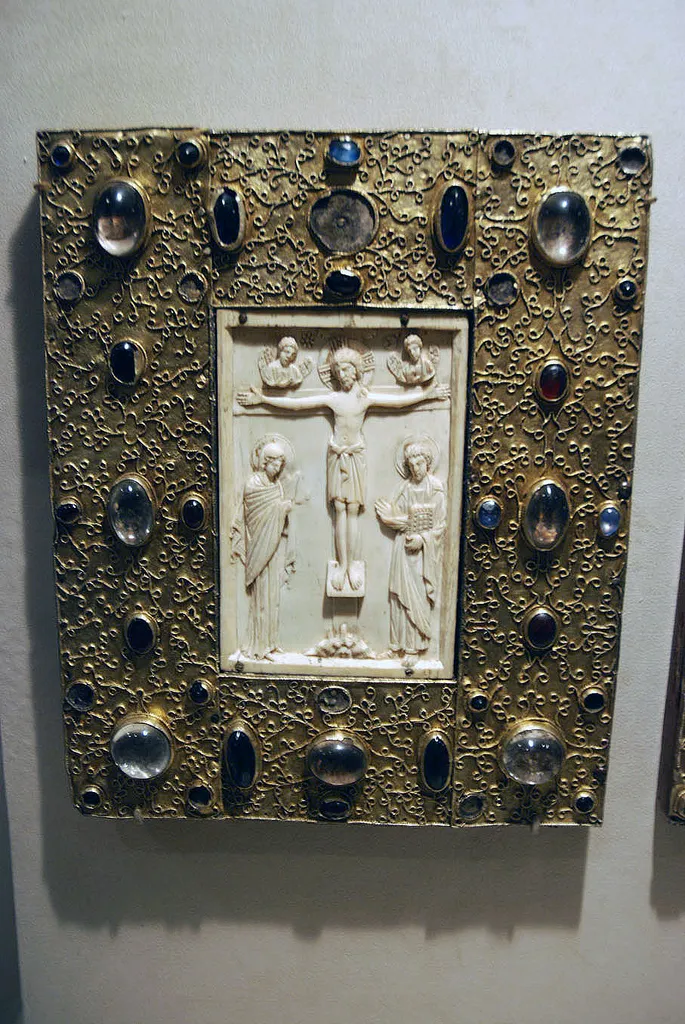
Photo: Wikipedia Loves Art participant "Random_Variables", CC BY 2.5, via Wikimedia Commons
Anniversaries are hard on objects. They compress decades of curatorial intention into a single season, they reward visibility over stability, and they ask institutions to make promises about the future at precisely the moment their calendars are fullest. In 2026 the United States observes two hundred and fifty years since the Declaration of Independence, and the commemorative apparatus assembled around that date — state heritage offices, diocesan anniversary committees, museum exhibition schedules, civic commissions — has begun reaching into sacristies and storage rooms where sacred icons have rested, largely undisturbed, for a century or more.
For stewards of sacred art, the semiquincentennial is a genuine opportunity to interpret collections for audiences who will not be this attentive again. It is also a conservation deadline that no one scheduled.
The Physics of a Spotlight
Light exposure is cumulative and irreversible. A painted panel that has spent forty years in a dim side chapel has an exposure history measured in thousands of lux-hours; a six-month loan to a major exhibition can double that history. Conservators commonly recommend that sensitive painted surfaces remain near fifty lux with ultraviolet filtration, and that display duration be tracked rather than assumed. These figures are not bureaucratic niceties. They are the difference between an icon that still carries legible inscriptions in 2076 and one that does not.
The same logic governs relative humidity, which anniversary committees tend to underestimate because it is invisible. Panel paintings move with moisture; gilding and ground layers do not. An icon that travels from a New England parish at forty percent relative humidity to a Gulf Coast venue at sixty-five percent is being asked to do something its structure may not tolerate. Stability matters more than any single reading: a gallery holding fifty percent year-round is safer than one that averages fifty percent while swinging twenty points within a week.
What a Loan Request Actually Asks
Loan paperwork arrives looking like paperwork. It is not. A facility report, an environmental log, a mount specification, a security plan, an insurance certificate, and a transit schedule together describe who is responsible when something goes wrong at two in the morning.
For a parish or diocesan collection with no registrar, a few habits repay the effort. Request the borrowing venue's facility report before agreeing to anything, and read the environmental section rather than the cover letter. Establish in writing who pays for crating, transit, courier travel, and any treatment required to make the object fit to travel — because treatment undertaken to make an object loan-ready is still treatment, and it alters the object. Confirm whether insurance is wall-to-wall or nails-to-nails, and obtain a valuation from someone who is not the borrower. Then ask what happens after the closing date. Objects travelling to a second venue accumulate a second set of risks, and calendars assembled quickly in an anniversary year have a way of extending themselves.
Provenance Work That Cannot Wait Until Spring
Anniversary programming brings press attention, and press attention brings questions. Icons that entered American collections in the middle decades of the twentieth century frequently carry thin documentation: a dealer's receipt, a family letter, a parish ledger with a date and no price. That is not automatically a problem, but it becomes one when an object is placed on a wall with a label and no file behind it.
Institutional due diligence commonly treats 1970, the year of the UNESCO Convention on the Means of Prohibiting and Preventing the Illicit Import, Export and Transfer of Ownership of Cultural Property, as a benchmark for acquisitions, even where United States law imposes no such requirement. Provenance research is usually framed as an ethical and legal matter. It is also a conservation document. A file establishing where an icon has been, how it was stored, and who treated it is the same file a conservator will need fifteen years from now.
The Constraint That Decides Everything: Staff Time
Small collections are limited less by money than by attention. One person — often unpaid — holds the keys, the records, and the institutional memory. Announcement of a major anniversary therefore produces a familiar pattern: enthusiasm, a hastily assembled display, and then a long silence.
A modest countermeasure is a single object file per icon, assembled once and kept current. Photographs of the recto and verso, a raking-light image recording surface deformation, dimensions, a materials note, a treatment history, and a provenance summary will serve a parish for decades. An inexpensive data logger in the display or storage space, downloaded seasonally, supplies a baseline that no amount of recollection can replace. And a one-page loan policy approved by the governing board ensures that decisions do not depend on who answers the telephone that week.
A Calendar That Fits the Year
Beginning in the first quarter of 2026, complete condition surveys and photography, and decide plainly which objects may travel and which may not. The second quarter is for agreements: executed loans, courier arrangements, verified environments, and written confirmation of the display period. By the anniversary itself, environmental set points should already be established and logged, not adjusted on the morning the doors open. Late summer and autumn are the season for rotation, since light-sensitive works should not simply remain on view until closing. November and December bring returns, quarantine, and post-transit condition checks.
After the Bunting Comes Down
The characteristic failure of a commemorative year is not damage but anticlimax. Objects come home, pledges go unfulfilled, and the energy that produced the exhibition evaporates before the storage upgrade it justified can be funded. A short debrief — what was lent, what was learned, what was spent, what remained undone — costs an afternoon and prevents the same discoveries from being made twice.
There is a compensation. The documentation produced during an anniversary year, however hurried, becomes the baseline against which the next generation will measure change. Stewards who recognize that are not merely participating in a celebration. They are writing the condition report that 2050 will depend on.