Before the Roofs, the Icons: Volunteer Conservators and the Race to Save Roadside Shrines
The waterline on the shrine of Our Lady of the Bayou stood at four feet, eleven inches — measured, with some pride, by the retired carpenter who had built the little structure behind his grandfather's bait shop in Terrebonne Parish. Hurricane season had pushed brackish water through the cypress walls, and when the volunteers arrived three days after the storm, the painted panel inside was soft to the touch, its surface filmed with silt and a bloom of white mold that seemed, to one observer, almost deliberate in its placement across the Virgin's face.
They did not wait for the insurance adjuster. They did not wait for FEMA. Four people in rubber boots and N95 masks lifted the panel, wrapped it in plastic sheeting, and drove it forty minutes to a converted garage that now serves as one of the Gulf Coast's more improbable conservation studios.
The Amateur Vanguard
Across the United States, a loose network of volunteer conservators — parishioners, hobbyists, retired tradespeople, and the occasional trained professional working pro bono — has quietly taken on the stabilization of religious images damaged in disasters. They are not professionals in the formal sense, though several have completed workshops through regional preservation organizations and state arts councils. What they possess is something the professional conservation field has always struggled to field at scale: proximity, urgency, and trust.
When a wildfire consumes a parish hall in California or a flood drowns a chapel in Appalachia, the certified conservators who might otherwise treat the damage are often weeks away and booked months in advance. The volunteers are there by the next morning. Their first interventions — drying, surface cleaning, support stabilization — are precisely the measures that determine whether a painted panel survives at all.
The field calls this first-response conservation. The volunteers tend to call it something simpler: taking care of what's ours.
Triage in a Garage
The Terrebonne panel, a mid-twentieth-century rendering of the Virgin and Child in the regional style sometimes described as bayou folk baroque, presented a textbook emergency. Prolonged moisture exposure had warped the wooden support into a gentle bow. The paint and ground layers were lifting in shallow blisters, and the mold, if left unchecked, would digest the animal glue in the ground layer within days.
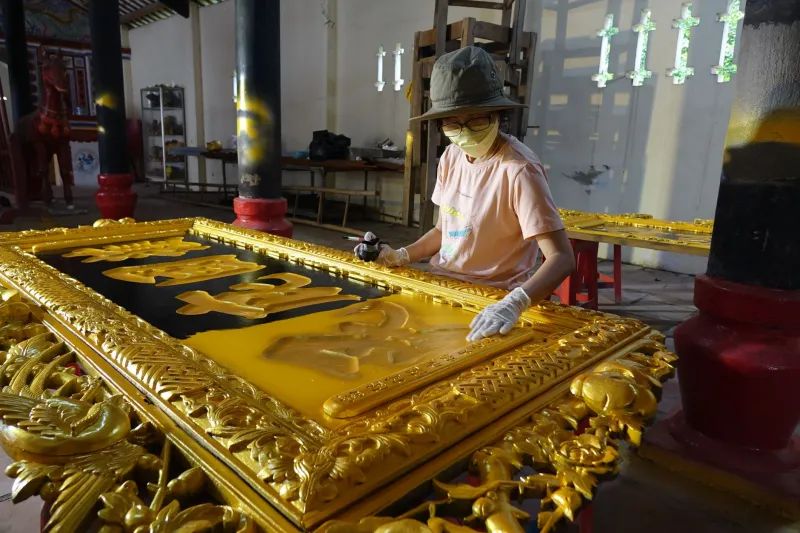
The volunteers worked in stages that would be recognizable to any trained conservator, even if the equipment was improvised. First, the panel was allowed to dry slowly under weight, pressed between blotting paper and boards to discourage further warping. Then came the mold: reduced with a HEPA vacuum, arrested with a light application of isopropyl alcohol on the reverse. The flaking paint was consolidated from beneath — warmed spatula, diluted gelatin adhesive, patient pressure — a technique one volunteer described learning from a two-hour video and a great deal of nerve.
The work took five weekends. The result, while not immaculate, preserved nearly all of the original paint, including the unusual detail that had made the shrine a local landmark: a fleet of shrimp boats rendered in the lower corner, their nets cast toward a horizon of gold.
Why the Saints Go First
There is a question that follows these efforts, sometimes asked gently and sometimes not: why does a painted panel outrank a roof?
The answer, volunteers and scholars alike suggest, is that the distinction is false. Sacred images function as anchors of identity in ways that structures do not. A sanctuary can be rebuilt from photographs; what the photographs cannot restore is continuity — the sense that the community's devotional life, accumulated over generations, has not been interrupted. Sociologists of disaster response have long observed that rituals and symbols recover before infrastructure, and that their recovery accelerates everything else. A restored shrine gives a congregation a reason to gather; gathering rebuilds the town.
There is also, volunteers admit, a plainer truth. These images are often the only objects a community has made collectively, maintained collectively, and grieved over collectively. They are not anyone's property in quite the ordinary sense, which is perhaps why no one hesitates to claim them in a crisis.
A Model Worth Documenting
For Iconsete, the significance of these crews lies in what they represent: an informal but remarkably effective layer of cultural stewardship operating entirely outside institutional frameworks. No national registry tracks them. Their methods are exchanged through parish bulletins, church basements, and word of mouth. Their documentation — when it exists — lives in phone photographs rather than condition reports.
Efforts are beginning to change that. Regional preservation nonprofits have started offering first-responder workshops tailored to volunteer crews, and a small consortium of conservators has drafted accessible guidelines for post-flood triage of painted religious objects. The goal is not to professionalize the volunteers but to arm them: to ensure that the gelatin is diluted correctly, that the mold is stopped before it spreads, that the impulse to save arrives with the knowledge to succeed.
The panel from Our Lady of the Bayou was reinstalled in a rebuilt shrine the following spring. The shrimp boats survived. So, the volunteers note, did the bait shop, the road, and most of the neighbors — in roughly that order of difficulty, and none of it, they insist, in the wrong order at all.