Ground Heaven to Dust: The Long Passage of Lapis from Afghan Stone to American Sanctuaries
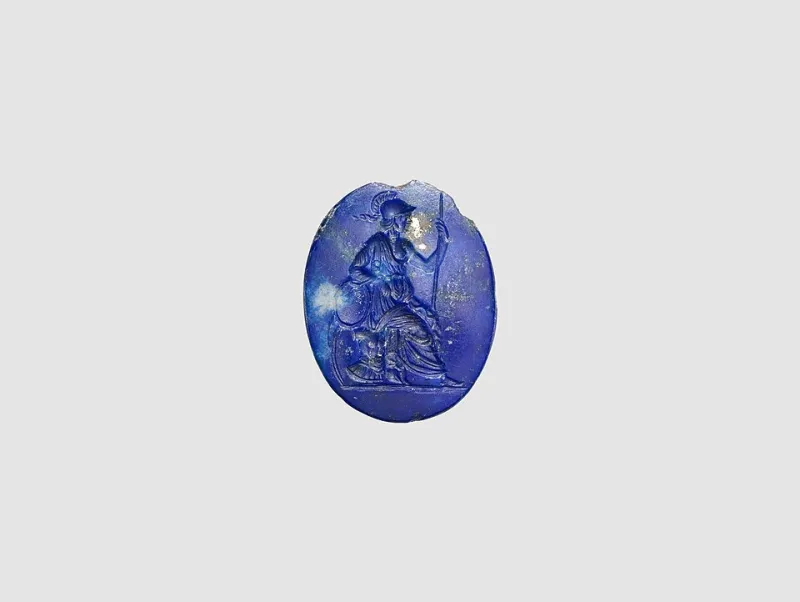
Photo: Unknown, CC0, via Wikimedia Commons
A Blue Worth More Than Gold
In the pigment cabinets of American conservation laboratories, a small vial of deep blue powder can be catalogued as carefully as any gold object in the collection. The comparison is not poetic license. From the Middle Ages until the early nineteenth century, natural ultramarine — ground from lapis lazuli — sold by weight at prices that frequently exceeded gold leaf, the very material it was painted beside.
For conservators, curators, and scholars of sacred art, that vial is a compressed history. It holds geology, medieval commerce, theological conviction, and the industrial revolutions that eventually dethroned it. To understand how a stone from one mountainside in northeastern Afghanistan came to sit on altarpieces in New York, Chicago, and Santa Fe is to understand that the history of sacred images has always been a history of supply chains.
One Valley, One Stone
Nearly all of the lapis lazuli used in European and Byzantine painting came from the Sar-e-Sang mines in Afghanistan's Badakhshan province, a deposit worked for more than six thousand years. The stone itself is a composite: lazurite provides the prized blue, but veins of calcite, pyrite, and sodalite thread through it, which is why raw lapis so often looks like a night sky scattered with golden stars.
Only a fraction of any rough stone yielded pigment-grade material. Blocks arrived in medieval Europe through a chain of intermediaries — overland caravan routes to ports on the Levant, then Venetian merchants whose very name for the color, oltremare, meaning "beyond the sea," became the pigment's name. By the time a guild workshop in Constantinople or Crete received a shipment, the stone had crossed deserts, mountains, and multiple empires.
The Theology of Expense
Why did painters and their patrons accept such costs? The answer is partly aesthetic — natural ultramarine possesses a depth and permanence that no contemporaneous blue could match — but it is chiefly theological.
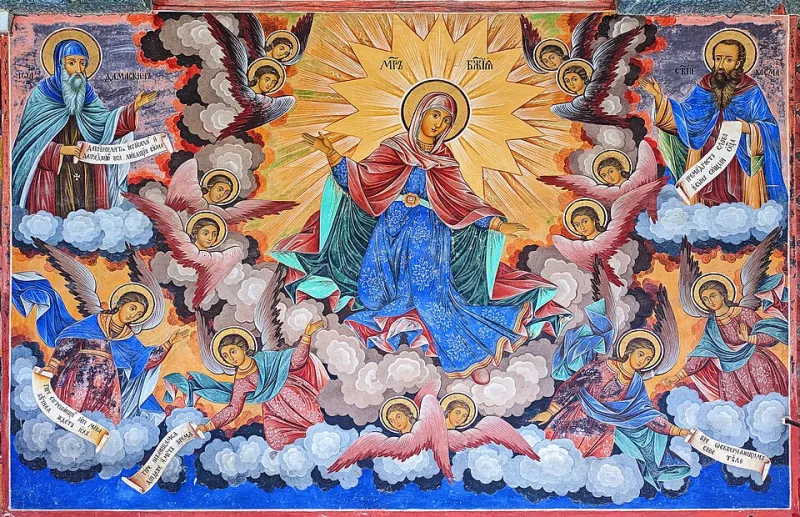
In the iconographic conventions inherited from Byzantium, the Virgin Mary's mantle was rendered in ultramarine because the color was understood as appropriate to her dignity: celestial, uncorrupted, costly beyond reckoning. Contract documents from Renaissance workshops routinely specified that the Virgin's robe be painted with ultramarine of a named quality and price, with cheaper pigment treated as grounds for legal complaint. The material itself was an act of devotion. Sacrifice was visible in the pigment layer.
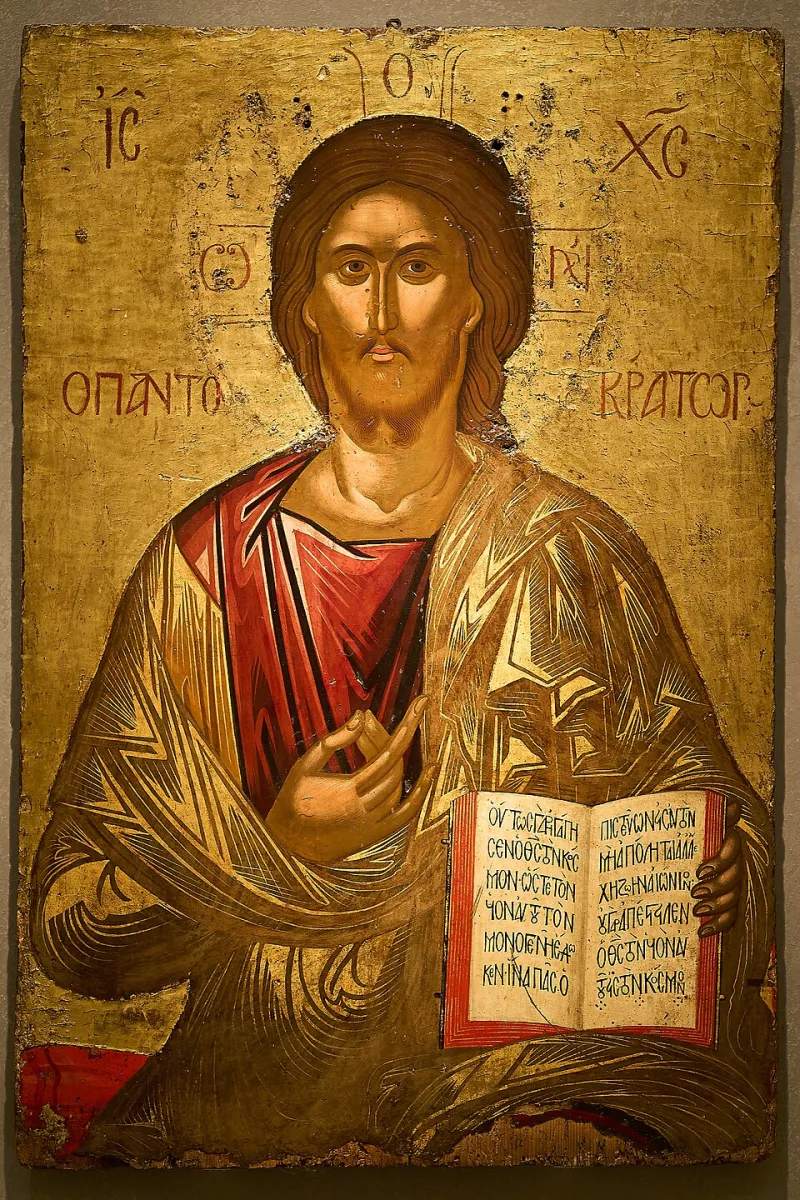
Byzantine and post-Byzantine icon painters worked within this economy of sanctity. A panel destined for a chapel might use ultramarine sparingly, reserved for the heavens of the composition, while lesser blues carried the secondary passages. Conservators today can read these decisions directly under magnification and elemental analysis.
Crossing the Atlantic
How, then, did this material reach the United States? Through several converging currents.
European émigré artists in the nineteenth and early twentieth centuries brought Old World workshop practice with them, and American churches commissioning Byzantine Revival and Russo-Greek style decoration — in cities with large Orthodox immigrant communities such as Chicago, Philadelphia, and San Francisco — demanded authentic materials. Dealers in New York imported raw lapis and prepared pigment for church decorators and easel painters alike.
Museums assembled their own holdings: panels and icons acquired by institutions from Boston to Los Angeles arrived with their original pigment layers intact, making American collections an accidental archive of the Sar-e-Sang trade. And when, in 1828, the German chemist Christian Gmelin developed a synthetic ultramarine, the economics of blue collapsed almost overnight — natural ultramarine became a rarity that American collectors and scholars would spend the next century studying, conserving, and revering.
Reading Pigment Like a Passport
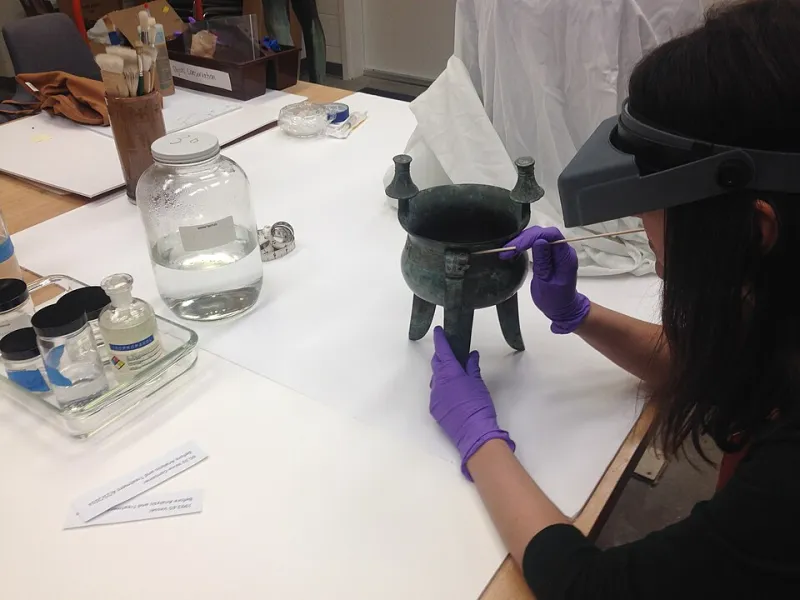
Modern conservation science has transformed what these paint layers can tell us. Raman spectroscopy and X-ray fluorescence allow analysts to distinguish natural from synthetic ultramarine non-invasively; the mineralogical fingerprint of the natural pigment can, in favorable cases, speak to geological origin and processing method.
For scholars, this matters in practical terms. Attribution questions — where a panel was painted, in which workshop tradition, whether it has been repainted or restored — often turn on pigment identification. A single cross-section the width of a human hair can reveal whether the blue of a Virgin's mantle was ground from Badakhshan stone or produced in a nineteenth-century chemical works, and that distinction can reorganize an object's biography entirely.
Stewardship Across Borders
The material biography of ultramarine carries a contemporary obligation. The Sar-e-Sang mines remain in production, and the trade routes that once carried lapis westward have been shaped, in every century, by the political fortunes of the regions they cross. American institutions that hold works painted with this pigment are, in a real sense, custodians of a shared transnational heritage.
That stewardship takes several forms: rigorous documentation of materials in collection records; support for training programs that teach traditional pigment preparation to a new generation of icon painters and conservators; and scholarly collaboration that treats the source communities and geological knowledge of Badakhshan as part of the story, not merely its origin point.
The Color That Remembers
Every surviving icon painted with natural ultramarine preserves two histories at once. There is the history the image was made to serve — the theology, the liturgy, the gaze of the sacred figures. And there is the history embedded in its matter: the miners of Badakhshan, the caravan masters, the Venetian factors, the workshop apprentices grinding stone in oil and gum.
When visitors stand before a Byzantine panel in an American museum, or worship beneath a domed ceiling washed in genuine ultramarine, they encounter a color that has crossed the world to reach them. Conservation's task — and the task of cultural stewardship generally — is to ensure that both of those histories remain legible for whoever stands there next.